
 Opinions are like bellybuttons: everyone’s got one.
I recently mentioned the AppleWatch to a friend, and before I could finish my sentence, he said, “Oh my GOD! The AppleWatch is SO dumb! Why would anyone want something so useless and so expensive?!” I was caught off guard—I was about to mention something I like about the watch, but all of a sudden I felt like I couldn’t say anything positive about it.
Everyone is entitled to their opinion. And everyone has the right to express their opinion. But there are lots of ways to express your opinion, from a brief mention to a forceful tirade. So which should you do, and when?
The first thing to do is consider whether it makes sense to share you thought or hold your thought. Some opinions are better left unsaid if all they’ll do is hurt someone.
So if you decide to share your opinion, should you be enthusiastic and passionate? Or calm and measured?
Only Enthusiastic
If you feel very strongly about your opinion, you may decide to share it enthusiastically. You state it with passion, because it is a very strong belief. It’s like a tidal wave, crashing to shore with incredible force!
 There are times when it makes sense to share your opinion with this much fervor. With friends who agree with you about how awesome the Minions movie was, be enthusiastic!
But if you are too enthusiastic, or too enthusiastic at the wrong time, you may have become “overzealous”—spending an extreme level of energy expressing a belief. You could anger or bother the people around you.
Only Measured
So if being too enthusiastic is a problem, what’s the alternative? Being measured. This is like calm waves on the ocean, moving slowly and evenly.
 Being measured is when you share your opinion in a calm and reserved way. When talking about a controversial topic, or with someone you don’t know well, it is often helpful not to share too enthusiastically.
But as with all things, being too measured can be a problem, too. People may think that you don’t care about your opinion. Being too measured could be mistaken for indifference. In those cases, other people in a group may make decisions without you, because they assume you don’t care. For example, don’t let your team at work decide everyone needs to come in an hour early if you have a very long commute and can’t make it!
Balancing Being Enthusiastic and Measured
Better than one extreme or the other, it’s best to find a balance between those two extremes:
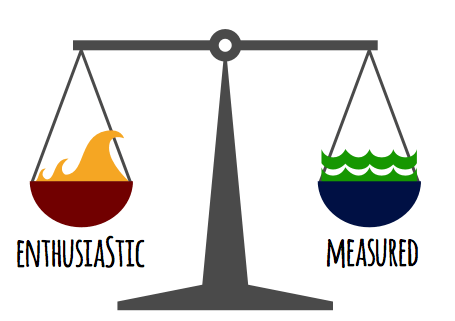
There are a lot of choices in between too enthusiastic and too measured. When having discussions in a group, consider just how enthusiastic or how measured to be when sharing your opinion.
Remember that sharing opinions has an impact on other people: it can make them uncomfortable, angry, or disappointed. OR it can make them interested, curious, inspired, or constructively challenged. And other people’s reactions all come back to you!


 Sticking with your way of doing things is like an anchor, firmly planted in the ocean floor. It doesn’t move, doesn’t budge for anything or anyone. This can be important to do at times, like when you are 100% certain that you need to take a break from a long work meeting (your way), even if others are insisting you stay.
 So what’s the alternative to sticking with your way? It’s trying new ways of doing things. For this, we use an image of a sailboat, whose route is guided by the wind. This is when we are open to advice and feedback, we listen to and consider the guidance of our relatives and peers and make changes in our behavior according to their suggestions.






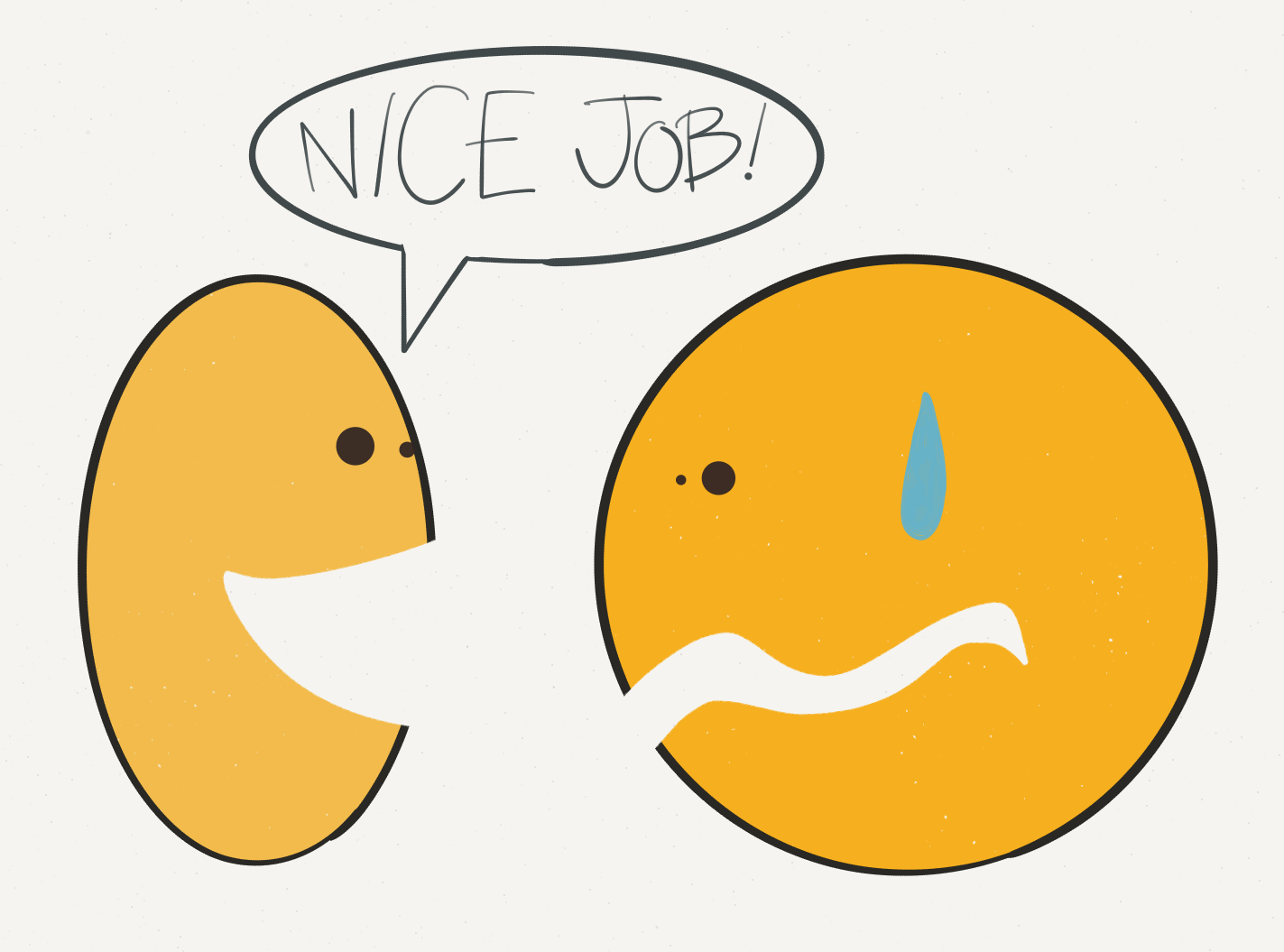




 In a world that puts so much pressure on people to assimilate and resemble others, being different can hurt…but learning to hide those differences? That can be equally destructive, if not more so.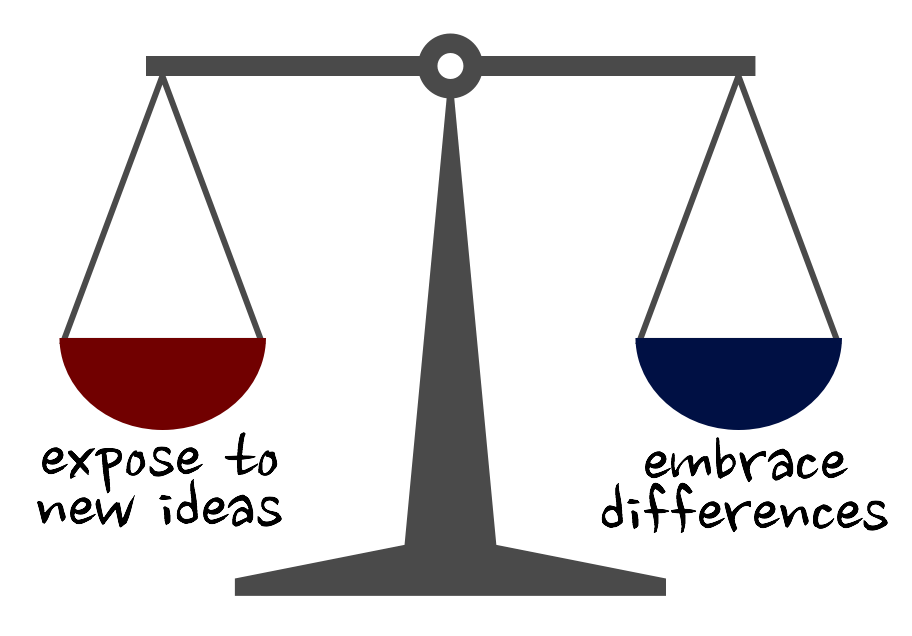
 Mental models are our values, beliefs, and a series of assumptions about how the world works. Unconsciously, we create a story about other people, institutions, and the world which drives our behavior. While everyone has them (in fact, we need them to make sense of the complex world in which we live), all mental models are flawed to some extent and usually invisible to us.


 Let’s help Henry make a decision by looking at a recent Balance Challenge





 Balance Challenge